LITTLE FOOD PASSPORT

AGES 3+

TURN YOUR
PICKY EATER
INTO A
FOOD EXPLORER

A physical and interactive booklet to help picky eaters experience new foods.

You put food on the table, they taste and decide what they like. Positive sticker progress, experimenting new food has never been that fun!

FREE SHIPPING

MOMMY OWNED PRINTED IN USA

Expert recommended. Kid approved!

As seen in PureWow

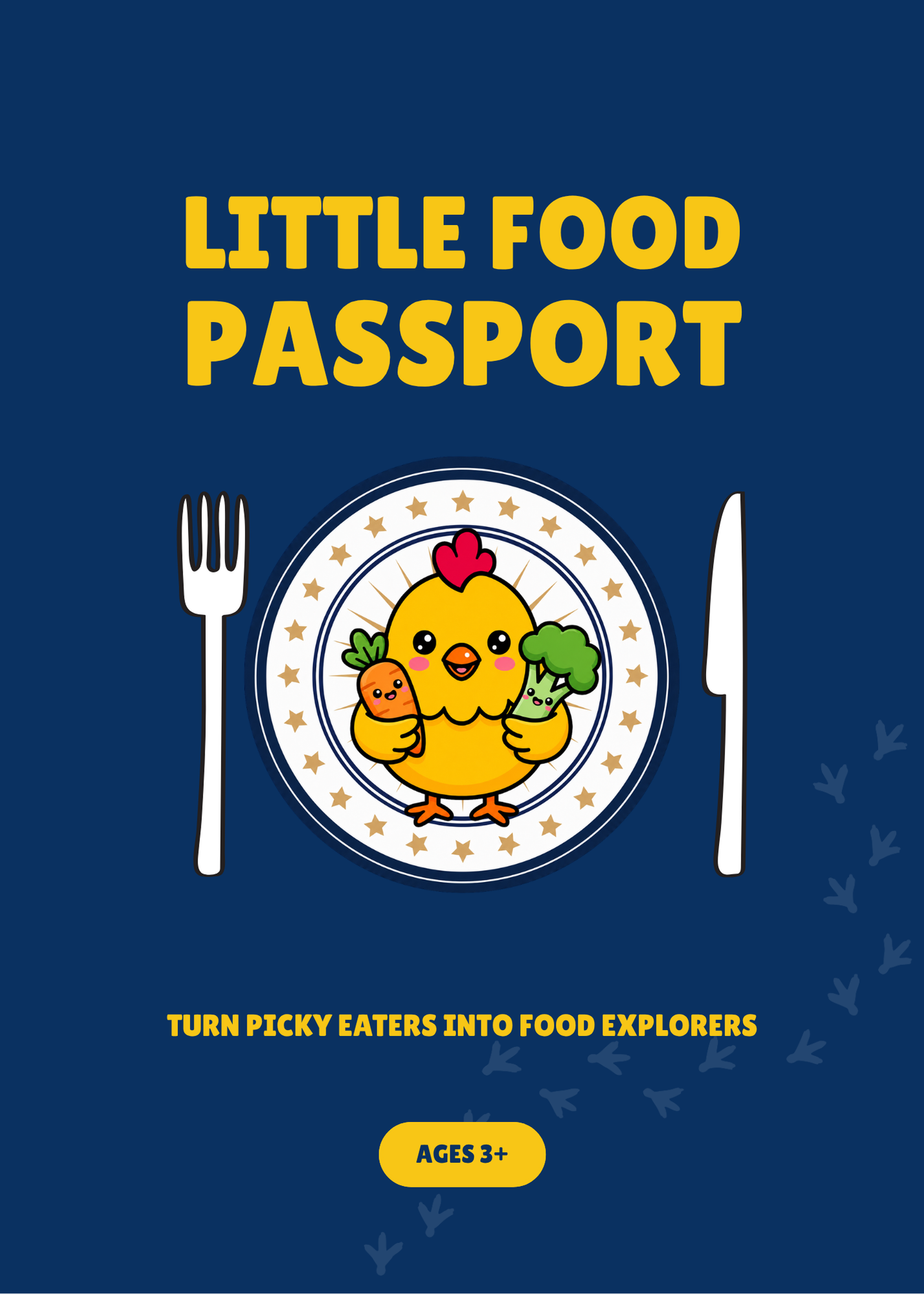
The Little Food Passport booklet cover

For children that are having trouble trying new foods, I love using the Little Food Passport to help them organize and track new foods they have tried. It helps kids build independence and confidence during mealtimes.”

Kate Bither Devore, MS, CCC-SLP, pediatric feeding therapist

100+ passports issued and counting

Big Chicken, the guide

Big Chicken runs the table. Your child follows him page to page.

How it works

FIVE FOODS.
FIVE PASSPORT VISAS.
ONE BOOKLET.

A fun, positive adventure with food, built on what feeding research actually shows: most kids need 10 to 15 tastes before a new food sticks, and pressure is what stops them getting there. One booklet is 25 low-pressure tries.

  1. Three they already eat, one or two they don't. Whole foods work best.

  2. An hour before: tell them tonight is a passport night. Let them help.

  3. They write the five names in the booklet and choose what to start with.

  4. Crunchy or creamy? Liked it, or try it again? They place the sticker themselves.

  5. All five tried? The visa goes on the meal page. Five visas fill the booklet.

WHAT'S INSIDE

Tap any spread to enlarge.

Track five foods at every meal
Earn the passport visa
Meet the stickers: no wrong answers
The certificate on the last page

THERE IS NO
"I DIDN'T LIKE IT"
STICKER.

The only two stickers are "I liked it" and "I'll try it again," because pressure and verdicts are what make picky eating worse. Every taste counts as progress, so there is nothing to argue about.

I liked it

I'll try it again

WHAT PARENTS ARE SAYING

ENTRY 01
"I love this booklet! It's transformed meal time and allowed me to add new food items my little one's lunches and weekly meals. THANK YOU!!"

Lyndsey B, Sacramento CA

ENTRY 02
"Mealtime was not just a time of frustration in our house but one that left me feeling guilt as I'd end up just serving mac'n cheese because it was easy. This system not only helped my son eat a variety of new healthy foods but was also a great bonding experience. He also asks if we're going to do the Little Food Passport at every meal. Love it."

Vince and Liz, Denver, CO

ENTRY 03
"THANK YOU THANK YOU THANK YOU! This was a fun way to introduce new foods into my daughters diet."

Carrie, Chicago, IL

OUR MISSION IS GROUNDED IN EXPERIENCE

A mom, a picky eater, and the dinner game that changed their table.

READ OUR STORY

Before you buy

FREQUENTLY ASKED QUESTIONS

What exactly is it?+

A 20-page activity booklet that comes complete with detailed instructions and stickers. It is a mealtime activity you share with your child, not a chart you hang on the fridge.

Who is it best suited for?+

Little picky eaters aged 3 and up: children who will sometimes try new food but are fussy about it, and parents who are tired of mealtime battles and want to work more healthy foods into the rotation.

Who is it NOT meant for?+

A picky eater is very different from a problem eater, and knowing the difference matters. If meals involve gagging or choking, your child accepts fewer than 20 foods, or there is weight loss or a medical feeding concern, a booklet is the wrong tool. Start with a pediatric feeding specialist.

How often should we do it?+

As much as you want. Some families make it a once-a-week event, others run one every night until the booklet is full. There is no schedule to keep up with — follow whatever your child asks for.

Which five foods should we serve?+

We do not make recommendations, because you know your child. Think through things you would not normally serve. We have seen more success with more basic foods to start, like steamed broccoli or boiled peas.

We have food restrictions. Does this work for vegetarian or vegan families?+

Yes. You choose every food your child tries. The booklet never names a food and nothing is included in the box, so no meat, dairy, eggs, nuts, or gluten come with it. Vegetarian, vegan, halal, kosher, or an allergy list: you fill the five slots with what already works for your table.

My child cannot write yet.+

If they can form their own letters, go around the plate and point out what each food is, then encourage them to write words next to the blank boxes. If they cannot, you write the names and they place the stickers.

How do the opinion stickers work?+

A smiley face sticker means they liked the food. The neutral face means they do not love it or hate it. Try to stay away from the idea that they did not like something: the point is to get their opinion without turning it into a verdict.

Why does trying it once count as a win?+

Most kids need 10 to 15 tastes before a new food sticks. One booklet is 25 low-pressure tries. To earn the sticker, they only have to explore every food on the plate, so every taste counts as progress.

Is this feeding therapy?+

No. It is rooted in research on the best strategies to help kids eat healthy, and pediatric feeding specialists recommend it, but it does not treat anything.

How fast does it ship?+

Orders leave our US printer within a few business days, and shipping inside the United States is free. We ship to Canada too; duties and taxes calculate at checkout.

What happens when the booklet is full?+

The last page is a certificate with your child's name on it. Plenty of families frame it or put it on the fridge, then start a fresh passport with five new foods.

Can they decorate the passport?+

Yes. The sticker sheet includes extras just for making the cover their own. When the passport is finished, snap a photo, tag @littlefoodpassports, and use #littlefoodpassport. We love seeing them.

Didn't find your answer?

Thanks - we reply within two business days, from a founder, not a bot.

START WITH TOMORROW'S DINNER.

One booklet. Five meals. Twenty-five chances for your child to try something new before you say a word.

The Little Food Passport booklet cover
STICKER SHEET
FILLED PAGE
CERTIFICATE

Ages 3+ · 2nd edition

LITTLE FOOD PASSPORT

{{ price }}{{ price }} for five meals and every sticker.

That is 25 tries at a new food, at {{ perTry }} each.

A 20-page printed booklet your child writes in and stickers at the table. Five meals, five foods each, one passport visa per finished meal, and a certificate at the end.

{{ qty }}

Ships in 2 to 4 business days · 30-day returns

WHAT'S INSIDE

Opinion stickers

Two choices after each taste: liked it, or try it again. No sticker means "I didn't like it."

Texture stickers

Words for what the food was like — creamy, crunchy, spicy, sour, sweet, salty.

Meal visas

One visa per meal, earned once all five foods have been tried.

Total pages20

Free shipping in the USA. For any other country, please contact us.

For bookholder, please contact us directly at hello@lilofoodpassport.com

HOW A MEAL GOES

You choose the plate: three familiar, one or two new.

They mark the texture, then how it went. No verdict to give.

Five tried, visa placed. One meal closer to the certificate.

"Most trackers ask a child to judge the food. This one asks what it was like, and then rewards the try. That distinction is the whole ballgame."

Name, MS CCC-SLP · pediatric feeding specialist

QUESTIONS PARENTS ASK

What age is this for?+

Three to six. Under three, the sticker steps are usually too much. Over six, most kids find the format young.

My child can't write yet.+

You write the food names, they place the stickers. The stickers are the part that matters to them.

Is it reusable?+

No. One booklet is five meals, written in and stickered once. Finishing it is the point, and the certificate at the end is why kids come back for a second one.

How long does a booklet take?+

Most families do one passport meal a week and finish in five to six weeks. Faster is fine. Skipping a week is also fine.

When will it arrive?+

Printed in the United States and shipped in 2 to 4 business days.

Is this feeding therapy?+

No. It borrows how feeding therapists structure exposure, and it is reviewed by one, but it does not treat anything. If your child gags, chokes, or eats fewer than 20 foods, see a specialist first.

REVIEWS

4.8 out of 5 · 312 reviews

★★★★★

"Bought it for the picky one, the older one wanted his own. Ordering a second."

First name, City

★★★★★

"Paper is thick enough that stickers come off clean if she changes her mind. Small thing, mattered."

First name, City

★★★★☆

"Wish it were ten meals instead of five. We finished it in a month."

First name, City

OUR MISSION: HELP KIDS EXPLORE NEW HEALTHIER FOODS

Hi! I'm Kathryn, the founder and creator of Little Food Passport. I'm on a mission to help parents get their children to try new healthy foods and establish a foundation for a life of healthy eating choices.

The Food Passport System is designed with parents and kids in mind. Picky eating can be extremely frustrating for parents who want the best for their kids. I developed this with my daughter who was the ultimate picky eater. As she grew into her toddler years, she moved away from the wholesome foods I'd been giving her and seemed to love only factory made foods. It worried me. It infuriated me. It made me feel powerless. The advice I sought out also didn't seem to help. Until one day, I decided to make a game out of trying new foods.

I prepared a simple meal of blueberries, yellow pepper, scrambled eggs and brown rice. Things she would never try. I sat her down and told her that we were going on an adventure! I took her through the activity and after we were finished, she tried everything on her plate AND liked blueberries, red pepper, brown rice. She didn't care for the eggs. She still doesn't (and that's ok).

Kathryn, Founder

GO BACK

GET IN TOUCH

Thank you, we will contact you soon.

LITTLE FOOD PASSPORT FOR CLASSROOMS AND CLINICS

Preschools, feeding therapists, and early-childhood programs use the booklet for group food exploration.

BULK ORDERS

Volume pricing for orders of 10 or more. Tell us your quantity and we'll send a quote.

CUSTOMIZATION

Covers, inside pages, or your program's name on the booklet. Ask us what's possible.

TRAINING

A short staff walkthrough for running meal adventures with a group.

We reply within two business days, from a founder, not a bot.

TELL US ABOUT YOUR PROGRAM

All fields are required.

Thanks - we reply within two business days, from a founder, not a bot.

Blog Articles

LEARN MORE ABOUT BECOMING A FOOD EXPLORER

The Science Behind Picky Eating: Genetics vs. Environment

How much of a picky eater is born that way, and how much is the dinner table around them?

MARCH 2026

Article title

One-line excerpt goes here.

DATE

Article title

One-line excerpt goes here.

DATE

Article title

One-line excerpt goes here.

DATE

THE SCIENCE BEHIND PICKY EATING: GENETICS VS. ENVIRONMENT

Kathryn Pfau·March 2026

Every parent of a picky eater eventually asks the same question: is this something she was born with, or something we did? The research says both, and the split matters less than what you can change.

What the twin studies show

Food neophobia, the reluctance to try unfamiliar food, is measurably heritable. Twin studies consistently find that a large share of the variation between children traces back to genetics rather than household habits. Sensitivity to bitter compounds is part of it: some children taste things in a raw brassica that others simply do not.

Chart placeholder — heritability estimates by age

What the table changes

Genetics set the starting point. Repetition, and the pressure around it, decide where a child ends up. Repeated neutral exposure to a food raises acceptance. Pressure to eat it lowers acceptance, sometimes for years. That is the finding that should shape dinner.

This is why a booklet that rewards the try, rather than the swallow, is not a soft option. It removes the one variable that reliably makes picky eating worse.

Chart placeholder — acceptance rate by number of tastes

What to do with that

Put the food on the table without comment. Let the child decide. Track the tries, not the wins, and give the same five foods more than three chances. The genetics are not going anywhere. The pressure is the part you control.

Related

START WITH TOMORROW'S DINNER.

Little Food Passport

Free Shipping (US)

LITTLE FOOD PASSPORT — STOREFRONT MOCKUP

Both frames load the same file. Scroll each independently.

DESKTOP · 1440

MOBILE · 390